Free, local, no signup

Recipe Converter

Your recipe serves 6 and you need 10? Paste the whole recipe, set the servings, and get a scaled ingredient list plus a grocery list.

Quick scale

The part most converters miss

Recipe scaling is not just multiplication

A cup is a volume, not a universal weight. Instructions are written for a specific pan, heat level, and batch size. This page keeps those distinctions visible.

01

Why 1 cup of flour is not 1 cup of sugar

Flour packs air between its particles; sugar crystals settle more densely. That is why one US cup of all-purpose flour weighs about 120 g while one cup of granulated sugar weighs about 200 g. The same sentence, “one cup,” can differ by roughly 80 g.
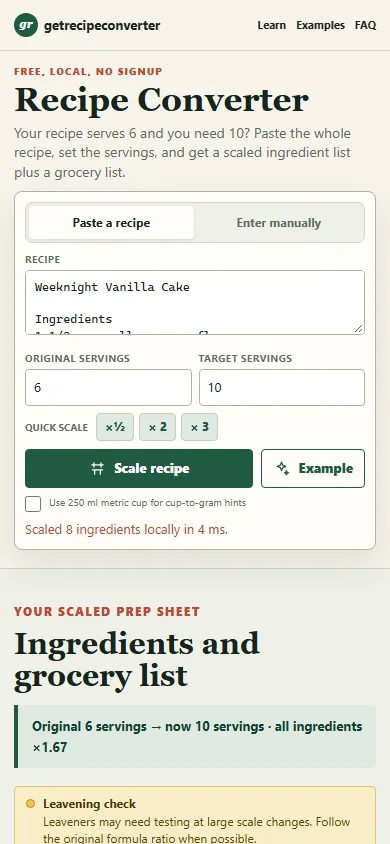
recipe converter showing 6 servings scaled to 10
The converter keeps partial eggs and cup-to-gram hints visible beside the scaled amount.

02

Common ingredient weights

Use weight when precision matters. Values are approximate and use a US cup of 236 ml.

Ingredient1 US cup
All-purpose flour120 g
Bread flour120 g
Whole wheat flour113 g
Granulated sugar200 g
Brown sugar, packed213 g
Unsweetened cocoa84 g
Old-fashioned oats89 g
Butter227 g
Water236 g
Milk244 g
Honey340 g
Long-grain white rice185 g
Vegetable oil198 g
Almond flour96 g
Cornstarch112 g

Reference values cross-checked against the King Arthur Ingredient Weight Chart and USDA FoodData Central data, rounded for kitchen use.

Quick references

Units, weight, and oven heat

Ingredient and unit converter Cups, spoons, fluid ounces, grams, milliliters, and pounds

US cup = 236 ml by default. Volume-to-weight conversion uses the selected ingredient density, not a fixed 236 g per cup.

Oven temperature converter Conventional, fan, Fahrenheit, Celsius, and Gas Mark

Gas°F°CFan °C
1275135120
2300150130
3325165145
4350180160
5375190170
6400205185
7425220200
8450230210
9475245225

What changes at scale

Five things a recipe multiplier cannot know

01

Salt, soy sauce, and spices

Start with roughly 80% of the mathematically scaled amount, taste, then add more. This is a working guideline, not an absolute rule; reduced sauces and salty ingredients can change the balance.

02

Baking powder, baking soda, and yeast

These ingredients are ratio-sensitive. Large batch changes can alter lift, proof time, and texture. The calculator warns you, but it does not pretend to replace a tested formula.

03

Eggs in baking

Eggs provide both water and structure. A fractional egg is easy to scale mathematically but not chemically. Whisk and weigh the egg when precision matters.

04

Time, temperature, and pan size

More batter in the same pan can burn outside before it sets inside. A larger pan changes depth and browning. The instruction text is never scaled by this tool.

05

Evaporation and surface area

A doubled sauce in a wider pot may reduce faster. Check consistency rather than multiplying the stated simmering time. This is especially important for jams, curries, and reductions.

Three worked examples

See the arithmetic

6 → 10 servings

×1.67, with normal kitchen rounding

Start with 1 1/2 cups flour. The exact multiplier is 10 ÷ 6 = 1.67, so the result is 2.5 cups. In a kitchen, 2 1/2 cups is the useful expression.

2 eggs × 5/3 = 3 1/3 eggs. Beat 4 eggs, weigh the mixture, and use about 3 1/3 egg equivalents.

8 → 4 servings

×0.5, then switch to grams

One cup of all-purpose flour becomes 1/2 cup. At about 120 g per US cup, that is 60 g. The same volume conversion does not work for sugar: 1/2 cup of granulated sugar is about 100 g.

Keep the oven temperature at the original setting unless the recipe specifically says otherwise.

Bread formula doubled

Why leavening needs attention

If a quick bread uses 2 teaspoons baking powder, doubling the flour and liquid does not automatically justify 4 teaspoons. The original recipe may already sit near the upper end of a useful range.

Check the recipe formula or baker’s percentage. Treat the calculator’s yellow leavening warning as a prompt to verify, not as an automatic adjustment.

A reliable sequence

How to scale a recipe without losing the plot

The safe default is simple: scale the ingredient list, then reconsider the method. Do not multiply a sentence just because it contains a number.

  1. 1
    Find the original yield. Confirm whether the number means servings or pieces; they are not always the same.
  2. 2
    Divide target by original. Use 10 ÷ 6 = 1.67 for a six-to-ten serving change.
  3. 3
    Scale only ingredient quantities. Keep “bake 25 minutes” and “preheat to 350°F” unchanged.
  4. 4
    Check sensitive ingredients. Taste after 80% of the scaled salt and spices; verify leaveners and eggs.
  5. 5
    Weigh when precision matters. Use grams for baking and convert cups by ingredient density, not with one fixed multiplier.

Common questions

Recipe conversion FAQ

How do I convert a recipe from 4 servings to 6?

Divide 6 by 4 to get 1.5. Multiply each ingredient quantity by 1.5. Keep cooking times and temperatures unchanged unless the recipe gives separate guidance for the new batch size.

How many grams is a cup of flour?

One US cup of all-purpose flour is about 120 g with a spoon-and-level measurement. Bread flour and whole wheat flour have different densities, so use the ingredient-specific table above.

How do I halve an egg?

Whisk the egg, weigh it, and use half. A large egg without its shell weighs about 50 g, making half roughly 25 g. For baking, weigh the whole whisked egg rather than guessing by volume.

Can I just double a cake recipe?

The ingredient arithmetic can be doubled, but cake recipes are sensitive to pan size, mixing, leavening, and oven airflow. Choose a pan with similar batter depth and expect to adjust baking time.

What is 180°C in Fahrenheit for a fan oven?

180°C conventional is 356°F. A fan oven usually runs about 20°C cooler than the conventional setting, so use roughly 160°C or 320°F.

Why does my doubled recipe not taste the same?

Salt, spices, leaveners, eggs, moisture loss, and browning do not all scale linearly. A larger batch also changes surface area and evaporation, so texture can differ even when the ingredient math is correct.

Does the converter change cooking time?

No. Steps, times, temperatures, and pan dimensions are omitted from the scaling operation. The tool shows a fixed warning whenever it detects instruction text.

Does this work without an account?

Yes. Everything runs locally in your browser. There is no account, no subscription, and no AI API in the core conversion path.